Recreational carp ponds often require chemical treatments to treat fish or algae/aquatic vegetation. To maximize treatment effectiveness and minimize the amount of chemical used, the appropriate treatment rate needs to calculated. Fortunately, with some basic information these calculations are not difficult.
What you need to know:
Pond volume:
Chemical treatments are based on their concentration in a known water volume. For ponds and lakes, volume is usually expressed by the term “acre-feet”. This volume is calculated by using the pond’s area (in acres) and multiply this by the pond’s average depth (in feet). An acre-ft is defined as the volume of one surface acre that is one foot deep and is equal to approximately 325,851 gallons.
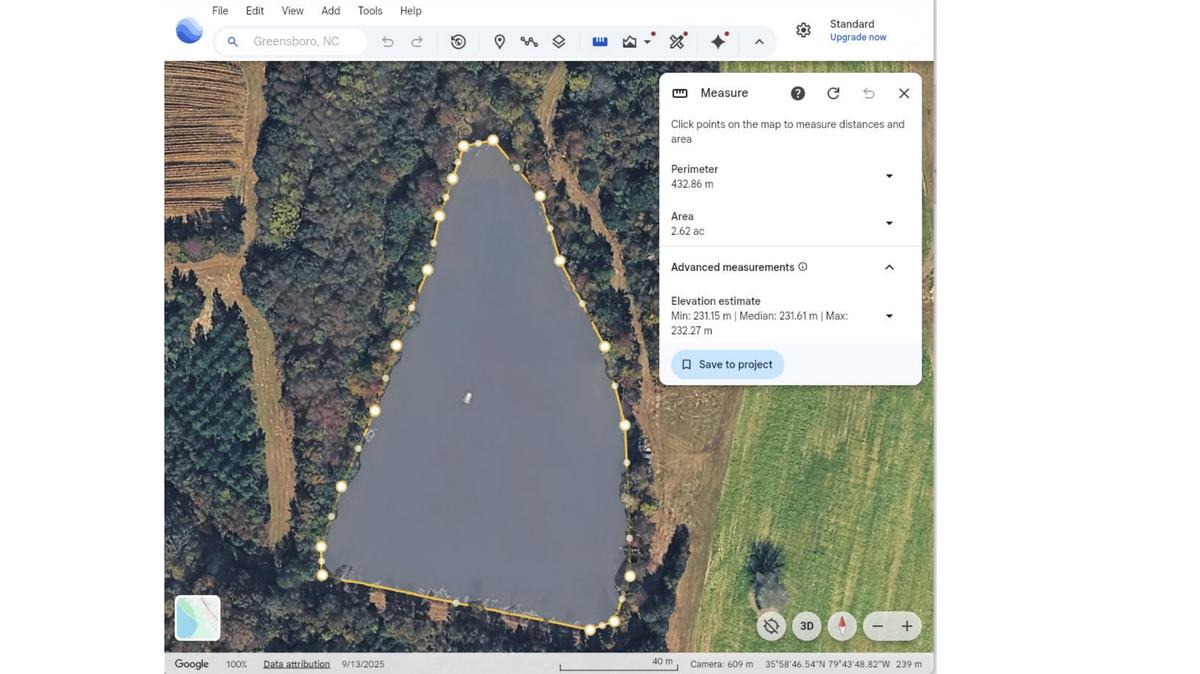
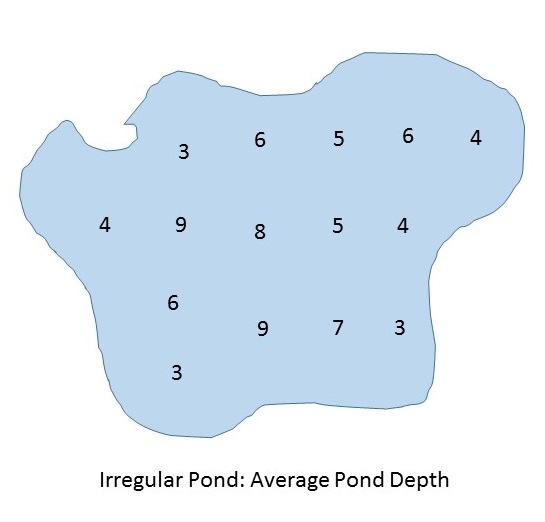
Determining pond area is not difficult using Google Earth™. Once you’re in Google Earth™, use the measure tool to trace an outline of the pond, and a side box will inform you the pond’s area and perimeter (Fig. 1). Unfortunately, calculating average depth requires taking actual depth measurement throughout the pond using a boat and a weighted line with depth markings. Depth soundings are taken in a grid pattern, which can be plotted on a simple map (Fig.2). The measurements are added up and the total divided by the number of measurements. The result is a reasonably accurate estimate of the average depth. The more measurements that are taken will lead to greater accuracy.
Pond Volume (acre-ft) = Surface Area (acres) x Avg Depth (ft)
Treatment Rate:
This is typically expressed as parts per million (ppm) or milligrams per liter (mg/l)). For example, a common treatment rate for potassium permanganate is 2 ppm (2 mg/l).
Treatments will be in a solid (crystal, powder) form or a liquid. When calculating treatment rates, solids are assumed to be 100% active ingredient (AI), unless otherwise stated in the label. Liquids will have a varying active ingredient percentage.
Once the water volume, treatment rate and chemical’s active ingredient percentage is known, it is possible to calculate the amount of chemical needed for a whole pond treatment.
For pond treatments using a solid chemical with 100% AI, the formula is:
Pond Volume x 2.72 x treatment rate (ppm) = Amount of chemical needed (lbs)
Potassium permanganate and copper sulfate are two chemicals that have 100% AI.
The following is an example of a calculation for potassium permanganate (KMnO4):
A 5-acre pond with an average depth of 6 feet requires a 2ppm treatment of potassium permanganate:
5 acres x 6 ft x 2.72 x 2ppm = 163 lbs KMnO4
If the chemical’s percent AI is less than 100%, the formula is:
Pond Volume x 2.72 x treatment rate / (%Ai x 0.01) = Amount chemical needed in lbs
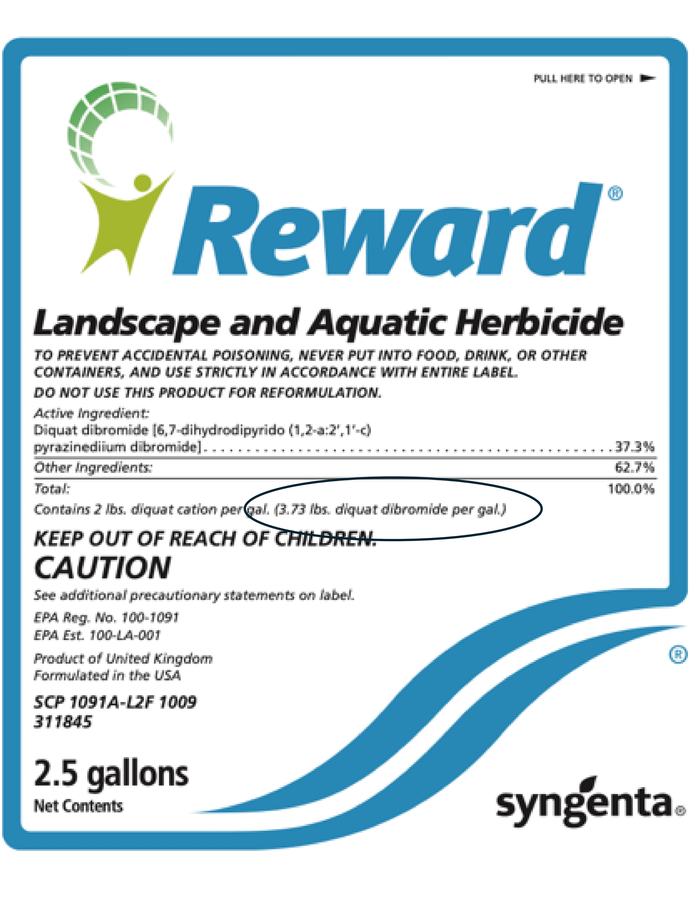
Liquid treatments may require the extra step of determining the pounds of active ingredient that are present in liquid. Aquatic herbicide treatments often require this step. On every liquid herbicide label will be a notation on the number of pounds of active ingredient per gallon of herbicide.
For example, the Reward® label (Fig.3) lists the product as containing 3.73 lbs of AI/gallon.
With this information the formula becomes:
Pond Volume x (2.72 / (AI lbs/gal)) x treatment rate = Amount Needed
Example calculation:
10-acre pond with an average depth of 5 feet needs a Reward (diquat) treatment of 0.5ppm:
10 acres x 5 ft x (2.72/3.73) x 0.5ppm = 18.2 gallons