I. Checking Females
- Anesthetize the females with about 0.3-0.5 gram of MS-222 (tricaine methane sulfonate) and 2 grams of baking soda (NaHCO3) per gallon of water using a 30 gallon trash can or comparable container. The females should succumb to the anesthesia in about one minute, at which time they can be handled safely.
- Check females once per week for ripeness starting 2-4 weeks prior to expected spawning period. A ripe female should have an enlarged abdomen and the vent should be extended and reddish in color.
- With the index finger and thumb GENTLY squeeze the female behind the pelvic fins and work toward the vent, feeling for a possible plug of old eggs, which must be worked out before the eggs will flow freely. Ripe eggs will flow freely with little pressure, they will be yellow to orange in color, and translucent. Allow a few eggs to drop into the water. If a milky coating is seen or dots are seen in the eggs, this indicates the eggs are over-ripe and cannot be fertilized.
II. Spawning
- Anesthetize females and an appropriate number of males. The ratio of one male to one female should be used if genetics are important. Strip the eggs from the female into a dry plastic pan and immediately apply milt from the male. Add enough water to cover the eggs and swirl to mix. Allow to stand for 2 minutes then rinse the eggs by filling the spawning pan with water and slowly pouring off the excess water and milt. Do this 3 or 4 times until the water left in the spawning pan is clear. Place eggs in a clean 5 gallon bucket filled with a 25 parts per million active iodine solution (Argentyne and Betadyne - 9.5 ml or almost 2 teaspoons/gallon of water; Wescodyne - 6 ml or slightly more than 1 teaspoon)/ gallon of water).
- Repeat these steps until all ripe females are spawned. Females will yield 1000- 4000 eggs per female depending on fish size, age, and health.
- Allow eggs in 5 gallon bucket to water-harden for one hour while providing adequate aeration.
Aquaculture: Brook Trout Spawning
Behind the Scenes: Trout Spawning
III. Incubating
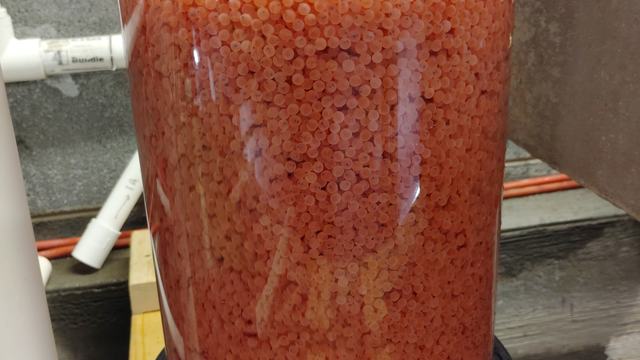
- Place a suitable number of eggs in incubator(s) to maintain adequate flow of water to eggs. (see Trout Production: Handling Eggs and Fry, SRAC 220).
- The eggs may need to be treated daily to control fungus. Formalin can be used at a rate of 1,000 - 2,000 ppm for 15 min in a continuous flow system (this is about 1:600 concentration of formalin or 48 fluid ounces/4 gallons per minute of flow). (see Trout Egg Formalin Treatment).
- Hydrogen Peroxide can also be an effective treatment for the control of fungus on trout eggs. Treatment rates are 500 - 1,000 ppm (mg/L) for 15 min in a continuous flow system once daily on consecutive or alternate days until hatch. (see Toxicity of Hydrogen Peroxide Treatments to Rainbow Trout Eggs, USGS)
- Incubate until eggs hatch (20-50 days dependent on water temperature), remove from incubators, and place in troughs or tanks.
- Carefully read the label for correct use of any chemical used for fungus control.
Additional Information:
Trout Culture in the North Central Region, NCRAC 108
Guide to the Small Scale Artificial Propagation of Trout, FAO